Showing posts with label Spandits!. Show all posts

Tuesday, August 9, 2016

Scrambled Legs & Aching and the Bitter Pill


It has been said that getting lost will help you find yourself... Photo  GMARA..

My husband Dave has been the best supporter of my adventure racing lifestyle over the last several years. Kid duty, photographer, race crew, tolerator of all things... just to name a few. I have tried many times to convince him to join me, but it wasn't until this year that he finally conceded. And just like that, team Scrambled Legs & Aching was formed for the 12-hour GMARA Bitter Pill Adventure Race held at Bolton Valley, VT.


Looking a little terrified during our pre-race official photo. At least we are in it together. Photo GMARA

Both Dave and I have a fair amount of experience in the disciplines of sport that would be included in the Bitter Pill. We are both experienced paddlers, are avid hikers, and ride mountain bikes all summer (admittedly, Dave much more enthusiastically so than I). We were both also well-prepared for some swimming or a ropes component, but those would not end up being part of this year's event. Orienteering, on the other hand, is an area where we are both inexperienced. I mean, I have watched other people navigate using a map and compass for whatever that is worth. Successfully navigating to the required checkpoints using a map and compass while biking, hiking, canoeing, etc. could prove to be an incredibly interesting challenge. There would be a good chance that much of our day could be spent lost in the woods. So, at 4 AM, we showed up at the pre-race meeting with our gear packed and compasses slung around our necks ready to learn what our fate would be.

The race began with a 35-minute bus ride in the darkness to the start location. At 5AM, we were led to a field of canoes and kayaks (with no water source apparent anywhere), handed our maps (made from data 30 years old), and instructed that all racers who arrived at the finish after 5PM would face a checkpoint penalty in accordance with how many minutes late they arrive. There was a loud and clear message in that directive: DON'T BE LATE! I wondered if we should just start looking for the finish now...

A cool photo of team Strong Machine snagging a
checkpoint on the paddle. photo GMARA

With first light illuminating the sky, we portaged our canoe overhead toward the first checkpoint about 1km away. We scrambled through long grass, over a barbed-wire fence, and finally roadside toward the muddy put-in on the Winooski river, which was running unseasonably low due to the dry summer conditions. The paddle to the first few checkpoints began in a pretty uneventful manner, and Dave and I settled in and started thinking that perhaps it was going to be a good day. The reality is, that things are never quite that simple. Not two seconds after Dave commented how his paddle was feeling unusually flexible in the water I heard the unmistakable crack of plastic snapping followed by several expletives from Dave. Gleaning over my shoulder, I could see there was clearly a problem; Dave only had 1/3 of a paddle blade attached to a cracked shaft. In all fairness, the paddle now made an excellent pole to push the canoe over the shallower sections of river. With a cracked shaft already, this didn't seem like the smart thing to do, however. So we paddled on, with the blade of Dave's paddle sounding like it had a sneaker attached to the end each time it punched into the water. Kerplunk, kerplunk, klerplunk. As the early morning fog hung low over the the river, the stillness only broken by the riffles of the current, we forged on, a little embarrassed that we were the only team of over 50 that managed a broken paddle in the first kilometer of the race. Kerplunk, kerplunk, kerplunk...
Paddling down the Winooski. It appears that we still have two complete paddles at this point in time. That portage totally destroyed my braid, but the way.  Photo GMARA

By the time we reached the next portage around a large dam at checkpoint #3, the race directors had caught wind of the rumor that a couple of suckers were paddling a canoe with only half of a paddle and a new paddle was ready and waiting. I began to wonder if we told them that we were missing a qualified navigator, they would have provided us with one of those too? I forgot to mention (yeah, forgot, let's go with that), that we missed the third checkpoint during this portage and had to run back to punch our passports.
Here is a funny picture of me trying to make sure that Dave stays up on his nutrition by forcing him to take his Endurolytes and Endurance Aminos. Eat it!! Photo GMARA.

The next several checkpoints were easily found along small tributaries, islands, or footbridges along the Winooski River. I was really grateful that they were all pretty easily navigated to, because paddling upriver for a missed checkpoint would be a real bugger. It was actually a beautiful and enjoyable paddle, and we arrived at the first transition area feeling great and in high spirits.
Punching CP #6 on the footbridge of the Long Trail. Ironically, Dave and I spent hours lost on the Long Trail with the kids near Smuggler's Notch this winter. We have since re-named it the Wrong Trail. Photo GMARA
TA 1 waiting for racers to arrive. Photo GMARA

The next leg was a mountain biking leg consisting of a small amount of paved road, to gravel road, to trail. We started out with a navigational mishap early on in the leg (oops, missed a turn), but found the checkpoints without too much trouble after that. This leg was around 27km in total- my estimation is that at least 24km of the leg was climbing (and lots of hike-a-bike). You might think this is impossible... that exaggeration is in my genetics.... I'll deny it. It IS entirely possible. Having just converted my mountain bike drivetrain to a 1X, I was definitely missing the existence of true grandma gear for the steeps. Let me tell you, that downhill was pretty exciting though (I might have yelled yee-haw once or twice, but I'll deny that too).
Headed out of TA 1 on the beginning of the bike leg. Photo GMARA

Dave on his way out of TA 1 Photo GMARA

We rolled into the second transition area (best guess at 11:30 am), dropped some gear and took a few minutes to plan our navigation for the next leg of the course. While the paddling and biking legs required checkpoints to be collected in order, this section was an orienteering section where eight checkpoints could be collected in any order. We made a plan to punch checkpoint (CP) #13 first and them make our way up the mountain to collect the checkpoints along a ridgeline and summit route afterward. We departed with Kate, Cliff, and Grey of team Strong Machine who were headed to the same checkpoint in search of a tributary intersecting with the drainage of Joiner Brook. We chatted along and probably were a bit distracted just long enough to
Headed out to CP #13 from the transition area with team Strong Machine.
Photo GMARA
misinterpret the scale of the map (which was made using 30-year old data), putting us further upstream than any of us realized.  After about 30 or 40 minutes of scouring several drainages (both dry and with flowing water), we all agreed that we were not near the checkpoint. Dave and I returned to the transition area and re-thought our scale, and resumed searching for drainages that appeared to match the drainage shown on the map further downstream (here is where I remember specifically being told not to rely on river drainages for navigation by one of the race directors the night before). Having lost nearly an hour, we decided on a different approach. We decided that we would not look for the drainage from the brook, rather we would take a bearing from a snowmobile bridge that seemed to appear on the map. We followed the bearing, only to wind up in the exact spot where we had been 20 minutes earlier. Still, no sign of the orienteering flag.


Here is a Google Map of CP #13. The CP was shown on our map (looked like this one, but much smaller scale) to be a little ways up the drainage shown as the southernmost E-W drainage intersecting with Joiner Stream. This is also likely based on 30 -year old data.


Here is a current GoogleEarth image- same scale. The drainage doesn't appear to be here at all any more. Furthermore, the character of the river is also entirely different from the GoogleMap above. I blame hurricane Irene for this chaos. That is my story and I am gonna stick with it.
Here is one reason to always question streams shown on 30 year old data.

Here is what I have learned that has been confirmed by other adventure racers since then: some check points just aren't meant to be found. At least, not by us. At least not on this day. Our difficulty on this day was that we weren't willing to admit that. Two hours later, we returned to the transition area once again, empty handed, baffled.

We now had around 3 hours remaining to search for checkpoints on foot before getting back on our mountain bikes for the final leg of the race. All of the checkpoints in this section were complete bushwacks- no trails, no significant drainages, and in most places the foliage was so thick it was difficult to see benchmarks like mountain tops or ridges. We decided to reverse our plan and approach the checkpoints in the opposite order, beginning with CP #14 and climbing the mountain from the other side, gathering as many as checkpoints as possible in the allotted time. The climb was steep, the vegetation thick (thanks for the souvenir, poison ivy), and the navigation was challenging, but we collected 4 more checkpoints in the next two hours. After a particularly thick section of bushwhacking reminiscent of our search for lost AT thru-hiker, Gerry Largay, in 2013, we approached checkpoint #18 around 3:15pm. After a pretty hasty search, we made the difficult decision to abandon the search for the checkpoint to return to the transition area, hoping to gather CP #19 on the way down the mountain. There would be no sense snagging checkpoints only to lose them in a penalty for arriving to late to the finish line. Unfortunately, as luck would have it, neither of those checkpoints would be punched on our passport either.

Nothing like rolling up to a finish line in grandma gear on the bike. I suppose that is better than pushing it though, right? Helmet with a hat? Really it IS a thing. Photo credit: GMARA

We made it to the transition area and hopped back on our bikes to ride up to the finish, collecting the final two CP's on the way up. It turns out that a volunteer at the transition area had given Dave a map that would show the current location of nordic trails that we needed for the remainder of the course. That map somehow never made it out of the transition area with us. Oops- rookie mistake #5 (or is that #6- but who is counting?). Luckily, the larger, older map would suffice since the journey was not too tricky (just peddle UP). All in all, we could collect 17 of the possible 21 checkpoints along the way and finish with 15 minutes to spare.

Maybe there was, after all, time to go back for CP #13? Not a chance.

Team Scrambled Legs and Aching at the finish after a great day of racing. Photo GMARA.
Thanks to the ladies at Spandits! (check out their awesome new prints! If you use code SPANDITSLOVE and tell them I sent you you'll receive 10% off your entire order). Also a shout out to the great folks at Hammer Nutrition (use this link to Hammer Nutrition for 15% off your first order) for fueling us through another great adventure. We felt great all day thanks to Hammer's awesome fuels (Heed, Sustained Energy, Endurolytes and Endurance Amino).

Finally, thanks to Shawn, Chris and the volunteers at GMARA for putting on an amazing event and generously letting me share their photos!

Wednesday, July 29, 2015

Part II- ACA Whitewater National Regatta on the Penobscot- Race Time!

Photo Tim Nutt
For anyone who reads this that hasn't paddled whitewater, I want to start by explaining how whitewater is classified, or at least how I see it. If you missed part I where I explain how I got myself into this, you can find it in my earlier post here.

Whitewater class system: Generally, there are 6 classes of moving water. Here is how I very unofficially define them.

Class 1- Moving water. Minimal hazards include some rocks or obstacles and eddy lines easily avoided. No real "white" water, although I've seen lots of canoes flip in class I water.

Class II- Hazards and obstacles include rocks, waves, and eddy lines... both can easily flip a canoe. With a relatively small amount of maneuvering, they can be avoided or paddled safely with correct bracing or bow angles. Rapids that are at the upper end of this difficulty range are designated class II+. 
Class III- More technical maneuvering is required to avoid hazards (strong hydraulics I will refer to as "holes", pour overs, etc.) that will definitely flip a canoe. Additionally, waves large enough to completely swamp a boat are likely and must be avoided. A failed maneuver will likely result in a swim- sometimes a lengthy one- for paddlers. Should only be run by experienced canoeists.
Class IV- In my opinion, class III and class IV are quite similar. The main difference here is about the consequence. In class III, a failed maneuver will likely result in a swim that will carry the paddler through more similar hazards as the ones described above. Self rescue is possible, but a total pain in the butt. Most class IV rapids have a class III line, you just have to stay in it. A class IV swim often means that the paddler will likely be carried into intense, powerful nasty hazards that can cause serious injury. Think Deliverance. Swimming through class IV is a pretty bad idea and your boat will likely be wrecked or banged up.
Class V- Violent, intense rapids where clean lines generally don't exist. Swimming through class V is a really, really bad idea. I've seen it happen, and it isn't pretty.
Class VI- Generally considered unrunnable. If you survive, you are one of the lucky few.

The ACA downriver event we would be participating in covered a 9-mile stretch of Class I/II water with 4 distinct sets of larger rapids. The first rapid was a short Class II+/III- section of whitewater, and the final three were Class III rapids. Prior to the event, Lani and I made practice runs of the entire race course 3 separate times to scout the river, devise a strategy, and get some idea exactly what we were in for on race day. Knowing the duration of the race would be well over an hour, we agreed that those who did well in the race would be the ones who had a solid strategy, stayed dry, and kept the boat upright. With my encouragement, we devised a conservative but smart plan for each of the 4 significant rapids. We agreed that small amounts of time might be bled by choosing conservative, safe lines, but we felt pretty confident that we could make up for our lack of whitewater prowess in the other river sections. After all, we reasoned, the chances that the margin between a podium or non-podium finish was unlikely to come down to seconds.


Penobscot tribal elder Butch Phillips leading the smudging ceremony blessing the river, the land and all of the racers before the first day of racing. Without the passion of the Penobscot Nation, none of this would have been possible. Thank you all.

We arrived on Wednesday night to attend the opening ceremony, which included traditional drumming and singing of traditional Wabanaki songs from members of the Penobscot tribe followed by a smudging ceremony conducted by tribal elder Butch Phillips. Before we knew it, the ceremonies and celebrations were over, Friday had morning arrived and we were making our final preparations at the river's edge for our race.


Boats anxiously waiting for heats to begin on Friday morning before the downriver start (Lani and I are in the center of the photo- red boat and Lani has a red life jacket). Photo MaCRO.

The race began below Indian Island in Old Town. Racers were sent off in heats every 2 minutes by class; ours was the OC-2W class (meaning open canoe- 2 women), the fourth heat of the day. The first rapid, the very spot where Lani and I took a humiliating swim during our first training run, would be only about 400m below the starting line. The entire class of female competitors charged toward the first set of waves, jockeying for position in the fastest water, shortest distance to the first bend in the river, and out of the path of hazards that could slow the pace or put water in the boats. While a few boats broke away from the pack by a couple of boat lengths, the entire pack remained tight and the intensity of race mode was evident in the first few paddle strokes. With two boats on our right side and another immediately in front of us, our plan to run the first rapid near river right was already thwarted. We adjusted to another course and continued through the rapid at a furious pace.


We entered this rapid at the same time as lots of the male OC-1 competitors from
the heats before us. Photo Cheryl Daigle.

The first major rapid would be at the site of the former Great Works dam, about 2 miles downstream. While we hoped to distance ourselves from other boats before the approach into the rapid, instead as we neared the rapid we found ourselves steadily approaching more boats from the men's heat released 2 minutes before ours. Additionally, despite the river being 400 yards wide in places, we found ourselves repeatedly colliding with the black Old Town canoe of Ander Thebaud and Tammy Kelley.  For the most part, I am pretty sure the collisions were inadvertent. Both boats were trying to stay in the fastest moving current while avoiding small obstacles and hazards along the way. As we began to overtake more of the men's boats, however, we found ourselves being pushed into the other crafts by the same black boat, time and time again. After a dozen or more collisions, two of which jammed the pinkie finger of my left hand between the gunnels of both boats, we had all clearly had enough of one another. From here forward, in my mind the black canoe became known as the pinkie-squishing Death Star.**

Other racers navigating Great Works. Photo Tim Nutt


Of all of the major rapids, the Great Works rapid was the longest and most difficult to prepare for, consisting of 3 or 4 drops separated by several holes, large waves, strong eddy lines, cribs and other industrial debris from the former dam. Having run it during our  3 training runs, two things were clear to me- 1) There really isn't a clean, dry line through this rapid, particularly the last drop and 2) The best line down the rapid changes even with small fluctuations in the water level. We paddled furiously toward the rapid in pursuit of the craft of Laurie Spraul and Kathleen Friday, Death Star at our heels, knowing full-well that we would be making decisions on the fly as to how to best negotiate the rapid. While our run through Great Works wasn't completely clean, I resisted my urge to grab onto the gunnels, close my eyes, and scream hoping Lani would paddle me to safety. We maintained our position through the drops while paddling with a quick, strong, clean cadence. In the last drop, we took on a small amount of water from a few large waves requiring some quick attention to bailing before resuming the furious pace set early on by the leaders. Lani and I both gasped for breath from the intensity of the chase, finding ourselves digging deep much earlier in the race than we possibly could have anticipated.
Lining up for the second drop of the Great Works rapid. I think this photo may have been taken on the second day of racing (the Sprint). Photo Tim Nutt.


The next 3 or 4 mile stretch of river was mostly moving water with class I/II whitewater. It was in this stretch where we made our first, and probably only, mistake of the race. Unable to lose the Death Star despite our best efforts, still ramming gunnels (I am pretty sure the men we were overtaking at the time found this pretty entertaining), we seized an opportunity to break off into a channel of water moving down the center of the river while the Death Star chose the flow on river right. With the slightly lower water level from our training run on Wednesday, this proved to be a bad choice. We found ourselves flailing against a swift current rather than being carried by it (not whitewater, just shallow ripples). We emerged a few hundred yards downstream now several boat lengths behind the Death Star. This deficiency we would never make up.

Despite an exhaustive pace, our positions on the river maintained relatively unchanged as we charged downriver toward the class III Basin Mills rapid. Basin Mills is a funny rapid. While short, the consequences of a bad choice are pretty unforgiving. The entry to the rapid consists of a ledge-hole about 100 yards wide in the center of the river (no, 100 yards actually isn't a typo). To the immediate right of the hole, there is a clean line of fast-moving water; however, just below the hole is a nasty, munchy, 6-foot set of curling, frothing, diagonal waves a few feet to the right. While the clean line was wide enough for a boat, an attempt to slide between the hole and the waves would have to be perfect or the consequence would likely be a boat full of water or a swim. During our practice runs, I felt this was the best of all of the options. The idea would be to set up above the waves further to the right than would otherwise seem prudent to ensure our bow was already pointed to the left below the hole. As the waves approached, we would thread the boat between the two hazards.

Here is the MaCKRO arial shot of the Basin Mills rapid. Fro above, it looks pretty small, but for perspective use the trees for reference. Those little ripples are actually big waves! Photo MaCKRO


Probably the hardest thing about the Basin rapid is that from the position on the river, none of the rapid is visible. The enormous ledge pour-over creates a horizon line that almost appears as a low-head dam would. It requires a tremendous amount of trust, commitment, and confidence in whatever approach you choose. As the rapid neared and we dropped to our low position in the boat to allow for better bracing, we were coming in a little further to the left than the from-the-right-approach we had planned. "Where is the freaking hole???" Lani demanded. "Right, further right." I insisted. I attempted to indicate where the hole was, but decided it was best to indicate where I wanted us to go, not where I didn't want us to be. I noted a kayaker further to river right. "Kayaker. The kayaker is on the line we want" I gasped. The Death Star disappeared out of view over the horizon line on river right. Further to the center, the other female boat still in front of us appeared to be headed right for the ledge. While I was certain this was a crazy move, it had also become clear that Laurie and Kathleen were extremely skilled and knew how the river fluctuated at different water levels better than we did. I could see them emerge a few seconds later below the drop, upright, and paddling downstream. If it was possible to run the hole without disaster, I knew it would be faster than the line we planned. It was time to take some risks if we wanted any chance of a place any higher than third.

"Change of plan." I said. "The hole is a better line." I knew Lani could only partially hear what I was yelling through the increasing roar of the river. "Left. Go left now."
"Are you crazy?" Lani hollered. "Honestly Shelley. Normally, I would never do this" she insisted with a very matter-of-fact tone. Not having said no, I knew she was not going to veto me. I continued paddling forward, now driving the boat towards the ledge drop and straightening it out in the final approach. Anyone who knows Lani and I knows this is a complete role reversal. "Oh, Jesus. You'd BETTER paddle hard" she said, hoping to avoid being flipped by the violent hydraulic directly below the ledge. And paddle hard we did. 

We emerged on the other side of what seemed like a black hole upright, dry, and smiling. The kayaker I had referenced just moments before was recirculating in the eddy below out of his kayak. "This totally sucks" he said, waving the rescue boat away to avoid a rescue-disqualification. With a now smaller margin ahead of us, the Death Star was furiously unloading gallons of water. "Let's get out of here" I announced in my best cliche-Hollywood-action-movie-voice. "We've got some boats to catch." 

Here are our friends Fiona and Emmanuel running Basin Mills during a training run. This photo is not race day- Basin is hard for spectators to access and photograph. Fiona Hamilton photo.


Shortly after the Basin rapid, we moved into second place, slowly gaining ground on the Death Star. The final set of drops would be at the site of the former Veazie Dam. During our training runs, we had chosen a conservative sneak-line on the righthand side of the wing dam that remained after removal of the larger dam. We knew this line would likely cost us 20-30 seconds from a more aggressive mid-river line, but circumnavigating the ledges and large wave trains would ensure that we would keep ourselves in the boat and the water out. We weren't in this to show off, we wanted to be smart. With our limited experience paddling against athletes of this caliber, we had never imagined that seconds would matter. 

Long before we arrived at the Veazie rapids, our well-laid plan was scrapped. In a language of broken sentences, gasps, and desperate grunts we agreed that we were headed for the more turbulent waters and ledges of the main flow of water. We'd figure out exactly what that meant as we went along. Unfortunately, only one time had we run the ledge during our first training run; that day we had found ourselves in a communication stalemate forcing the bow to swing out wildly sending us over the final drop backwards. We weren't hoping to repeat that. 
Veazie rapid. There are several canoes in this shot (they
look like little fish) that add a good frame of
reference. photo MaCKRO.

I selected one of the routes I knew other paddlers had used along the left side of the wing dam. Despite the hard, strong paddle strokes that caused my shoulders, back, and quads to ache (? don't ask- I have no idea why) and now beginning to seize up, paddling down the Veazie dam felt more like paddling in molasses than water. "Don't quit" we reminded one another every few strokes. No matter how hard we paddled, how hard we dug, the Death Star just wasn't getting any closer to us. In fact, throughout the rapid they actually appeared to have gained a few seconds on us, despite our more aggressive line and exhaustive paddling. The rapid came and went, as did the remaining quarter mile of river below the final waves and turbulent waters of the final class III whitewater. We laid it all out there on the river. In the end, we came up 24 seconds short.

Or, you could say, we came in 29 seconds ahead of third. Only eight minutes ahead the last boat. In the past, we have done races where a close margin between 2 boats was 10 full minutes. As we swung into the eddy and laid in the boat to catch our breath, it became clear just how awesome this field of ladies had actually been. Nearly all boats in the field were visible in the small section of river that could be seen upstream of the finish line. Never in my life could I have imagined a race could be so close. Or so hard. Or so fun.


Women's second place in the downriver race! Thanks always to Spandits! and Hammer Nutrition for your support for my adventures. Anti-Fatigue Caps and Hammer Gel at the start and Recoverite at the finish was the perfect combination. 


At some point, for those who are actually interested in the stuff, I'll tell you about the Sprint that followed on the next day (the race was just the Great Works rapid). Spoiler alert: we were second again. I know what they say about second place, but I have to say, I couldn't be more excited or feel more accomplished.

**Note- I mean no disrespect when using the term Death Star. In fact, we actually chatted and joked with Ander and Tammy after the race and they both seemed like really nice gals.


Monday, July 27, 2015

Who Wants to Take up Whitewater Canoe Racing??

"Winning has nothing to do with racing. Most days don't have races anyway. Winning is about struggle and effort and optimism and never, ever, ever giving up." Amy Burfoot- The Runner's Guide to the Meaning of Life.
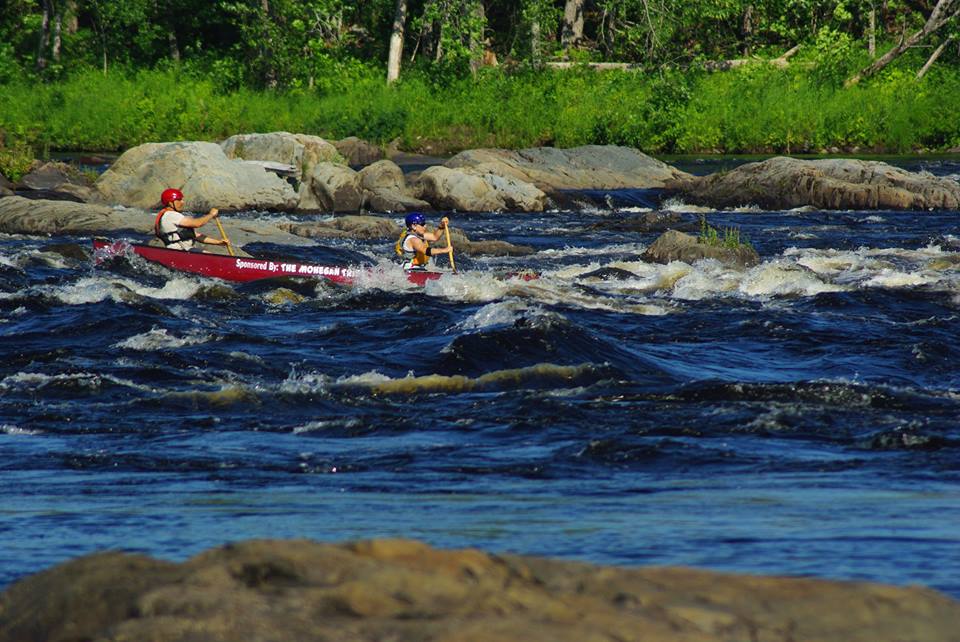
Arial shot of one of the rapids of the Penobscot paddled in the whitewater regatta. What look like little ripples are up to seven foot standing waves!

It is safe to say that I find whitewater intimidating. Very intimidating. Back in 1997, I had my first real encounter with whitewater when I learned to kayak at the School of Hard Knocks. My well-intentioned now-husband Dave introduced me to paddling, and often swimming, in big water in Idaho. For the most part, it didn't go well. Having swam through violent whitewater, enormous crashing waves, and the churning pour overs and holes of both the Selway and Salmon rivers during our summers in Idaho, I was forced to master the art of self-rescue in class IV rapids. Needless to say, long ago I learned to develop healthy respect for what the power of moving water can do to the human body. Upon moving back east in 2000, I turned my whitewater kayak into a flower pot.

So, fifteen years later, it is clear the logical thing to do would be to hop in an open canoe and sign up to race through whitewater. At Nationals. Seems about right.

The Whitewater Nationals Regatta is a 4-day event put on by the American Canoe and Kayak Association that is held annually on various rivers throughout the nation, most recently being the Nantahala River in North Carolina. When Lani and I heard that the event would be making a return to the state of Maine, we were curious about the possibility of registering a boat to see how we might fare. Besides the caliber of canoeists who would be competing in the ACA Whitewater Nationals, one of the more exciting aspects of this event was the fact that the race was to be held on a stretch of the Penobscot river that has only recently been open to paddlers. The waterway has been home to the Penobscot Indians for thousands of years and was used by tribal members as a travel route until the 1800's when the river was blocked by two large dams. In the last three years, the Penobscots have purchased and decommissioned the dams, returning the waterway to a free-flowing state that hasn't existed for hundreds of years. For the paddling community, the restoration work of the Penobscots and the class III whitewater that now stands in the place of these dams has been a much appreciated gift.


A training run on the third drop at the site of the former Great Works dam. I am pretty sure this is our friend Fiona paddling. -with Fiona Hamilton.


We knew that without a doubt we would compete against paddlers with years (or decades) of experience that we lacked in whitewater canoeing. We also knew that our inexperience working as a paddling duo would not work in our favor. Nevertheless, our desire for a new kind of adventure surpassed any real common sense that would otherwise dissuade us from registering. We immediately signed up and made our training plan.

The physical conditioning was the easy part... actual on-water training time? Not-so-much. Schedules, families, work, and sheer distance to moving water from our homes made it difficult for us to get together more than a dozen times from April to July to come together on the water to prepare ourselves for what was to come. When we couldn't paddle together, we made time on the water separately.  During our on-water outings, we worked on cadence, paddle strokes and technique, reading whitewater, and most importantly, communication. Having been close friends for years who have talked about just about anything imaginable along our adventures, it would seem that this would be where Lani and I would have an advantage. For anyone who has canoe-raced in a tandem boat, you must know that we were terribly mistaken. Instead, we were in for a steep learning curve. If we were going to survived this event, here are some things we would need to consider...

1) Who is in charge of making decisions? Who picks the line? If one person wants to go right around a hazard and the other wants to go left, the compromise is going straight over it. That kind of compromise is bad for everyone. Don't ask me how I know that.
2) How do you execute the plan once you have it? Who makes the corrections? Draw from the bow while the stern maintains forward momentum, or are correction strokes made from the stern? How do you make these adjustments while maintaining speed?
3) Here is my favorite one. "Left!!". What does that really mean? Does that mean to go to the left of a hazard, or watch out for what is on the left? Should I keep the hazard to my left, which would really mean to go right? I can't begin to tell you how many hours we spent working that one out.
4) Decisions in canoe racing are made on-the-fly in split seconds, involving more than one brain to execute a plan, albeit sometimes a questionable one. How do you keep both teammates in synch? How do you learn to trust someone else?

Our little team. A finely tuned machine....


So after some experiential learning, we determined that from he position in the bow, I would pick the lines. I would find the safest, fastest water on the river at all times. Lani learned to trust me (which I know was probably difficult, especially in the beginning). I would make the call, Lani wouldn't question or argue. From the stern, Lani was otherwise the captain. I learned to respond to commands like "draw", "cross-draw", "brace", "PADDLE HARD", "lean back", and "goddammit Shelley!" like a golden retriever waiting for a ball. And thus, our little team was born....

Once the preliminary training work was done, we headed over to Old Town to pre-run the race course, build our confidence, and make final adjustments as needed. Turns out, adjustments were much needed. Within about 400 meters of the 9-mile downriver route, we were out of the canoe and in the water. Swimming. 


From the looks of it, Lani and I weren't the only ones figuring things out as we went along. - Photo Tim Nutt.


Coming soon.... Part II: The Regatta.....


Sunday, December 7, 2014

Untamed Adventure Racing: Dover Raid


"Happiness is only real when shared."- Chris McCandless, Into The Wild


Last week I had an interesting conversation with the new barista at my favorite (and only) local coffee shop about adventure racing. She asked me if considered these races to be Class I, Class II, or Class III fun. When I asked her what that meant, she explained that class I fun is when the event is purely fun, and you are aware of such even while you are doing it. Class II fun- not so much fun when you are doing it, but after it is over, it is good fun. Class III- not fun during, not fun after, but when you look back on it a year later, you think to yourself "wow, that really was life changing and fun". I thought that was an excellent way to sum up my idea of fun. Most races for me are a little bit of all three.
Great race swag. A lovely Colombia top for me and a OR
running cap for Dave. Thanks MadAthlete.com!

Despite having hung up my shoes for the 2014 season two months ago, I wasn't able to resist the temptation to jump into one more event before the end of this year. Untamed Adventure Racing, the same organization that put on the 4-day Untamed New England and North Country Endurance Challenge, had one more event up their sleeve: The Dover Raid. This event is a 6-hour orienteering foot-race in Dover, NH. Forty-seven checkpoints would be scattered throughout the city and outlying areas and racers would scramble to complete as many as possible in the allotted time (and awarded 1 point per checkpoint successfully punched). Racers arriving at the finish at the Cara Irish Pub in downtown Dover after 5 pm would be docked 1 point for every minute late they arrived. This race was to be Class I fun all the way. I teamed up with my husband, Dave, and two other friends who each registered as solo racers. My intention for this race was entirely to remind me why I love adventure racing and to be surrounded by the kind of people who remind me to live life to the fullest.

(No expectations is probably a good thing since my training has not included much running at all due to a gnarly case of plantar fasciitis.)

Dave and I awoke Saturday morning at my cousin's place Portland to a sheet of fresh snow and ice on the ground, mid-30's temps, and sleet and rain falling from the sky. This was not going to be a dry day for us, that was already clear. Icy roads, lack of preparation, and dragging our heels a little due to the cold start brought us the venue only 15 minutes before the bus departed for the start. It was astonishing how many people were already packed into the tiny pub receiving instructions from RD Grant Killian as we arrived (late). The only part that I actually was able to hear was that checkpoints 22-29 probably should not be attempted by teams without adventure racing experience as they involved sketchy, icy, log crossings and that there would not be a bailout option for anyone deciding to call it quits in this section of the course. Apart from that, we pretty much missed all other instructions. We grabbed maps and boarded the busses to the start using the 15-minute bus ride to organize our packs and maps and layer up into our most waterproof layers. Dave, James (one of my teammates from Executive Athletes), his girlfriend's dad Mark, and I decided that we would stay together as a team for the day. We hopped off the bus and assembled for a final short speech to racers before the official start. I was off using the woods as a bathroom as the race started. I emerged struggling to get my tights up, ankle deep in thick slush, into a pack of racers and followed the boys off onto the trails tucking the passport, compass, clue sheet, and Hammer Gels into my pack as I ran.

Just like that- as quickly as we started- we were lost. I am not sure if it was a lack of communication about what checkpoint we were headed to first, or a case of upside-down map syndrome, but we had no idea where we were. Attempting to salvage our start, we headed further into the woods hoping to find some clue that we could use to locate ourselves on the map. By the time this happened, our only viable options were to start at CP 15 (checkpoint 15) and work our way back to CP 10 or to retrace our foot steps back to the start and complete the CP's in order as we had planned. We opted to break trail through the woods directly to the outlying CP 15, return backwards to pick up the lower # CP's, and retrace our steps to CP 16 and beyond (meaning that we would run head-on toward most other teams). All told, this probably cost us 45+ minutes and several additional miles of slushy bushwhacking on trails in the woods on the outskirts of Dover. We emerged from the woods to CP #18 soaking wet where hot coffee and warm smiles greeted us and checked us in. The good news- that coffee was amazing. The bad news: we were basically last. Dead last. Oops. Here Grant mentioned that several teams ahead of us had opted to skip CP's 22-29 after having seen the log river crossing. Evidently, it was high above the water, coated in ice, and sketchy as he had said earlier. Skipping these CP's was probably the best choice for a team looking to be competitive at this point: the CP's in town would be much closer together and require significantly less time, distance, and energy to gather. Unless clearing the course was the objective (getting ALL CP's), the faster route back to town was probably the better choice for racking up points. Regardless, we decided to head to CP's 22-29 anyway. The wooded checkpoints looked like they would be way more fun than heading back to town. None of us would regret this decision.
Several teams at one of the tree crossings. Photo Lars Blackmore.

This section of the course was gorgeous. We crossed a couple of rivers in a few places, but most of the time we found a downed tree or other way across that prevented us from getting wet(ter). The icy tree was a little sketchy: I later heard one group had a team member who freaked out and froze half way across the log. Someone else dropped their maps into the river below in this spot. As far as I know, no one actually took an unexpected swim here though. The four us were thrilled to just be out there gathering checkpoints. Apart from a couple of differences of opinion here and there, we smoothly transitioned from CP to CP for the next several hours. Mark eventually decided to head back toward town to get warm as his hip had had enough, and Dave, James, and I continued on down a slush-covered railroad bed in search of checkpoints. It was fun watching Dave and James frolic down the trail ahead of me like two school kids on a snowday. We arrived into town with only about 40 minutes remaining and picked up the pace to try to snag as many more CP's as we could before the 5 pm cutoff. Indeed, these CP's were low-hanging fruit compared to some of the others. In hindsight, it would have been nice to have more time to grab more CP's in town- but I wouldn't have traded the adventure for extra checkpoints. We ran at a decent clip for the last several miles and arrived with only 8 minutes to spare.

Greeted with pizza and beer at the finish!

We were greeted at Cara Irish Pub to warm food and beer and everyone was in great spirits. Awards
and swag were distributed (thanks MadAthlete.com). One team of two men did clear the course- I am not sure what the total distance was but last year it was nearly 30 miles. In the slushy conditions, completing every checkpoint was an impressive feat. Despite our rough start, we cleared around 30 CP's, although I am not sure of our official placement.

All race proceeds for this event were to be donated to the family of Chad Denning, a fellow adventure racer who died while on a trail run on the Appalachian Trail in September. While I never met Chad, Grant's emotional tribute to him made it obvious that he was more than an athlete; rather, a dear member of an extended racing family. It is clear to say, without a doubt, that these races are a labor of love, rather than for profit. Love of community. Love of the outdoors. Love of adventure.


Chad Denning with his family in 2013. Photo farnorthendurance.com

Thanks to the folks at Untamed Adventure racing, 2014 has made me a believer.


Thanks to Hammer Nutrition for my go to Hammer Gels, Endurolytes and Endurance Amino. They powered us all throughout the day feeling awesome! Click on the link above to receive 15% off your first Hammer order!

Also special thanks to Sarah and Kelly at Spandits! for our awesome tights. Dave's camo thermal tights were absolutely perfect and my circus act full-length tights with a wind layer were a winning combination! Use my code SPANDITSLOVE for 10% off your order!


Monday, July 28, 2014

Spandits 5K and kids 1-miler

Great race swag at the Spandits! 5K. I would have included a photo of the homemade cake too, but we ate it.
For years, I've heard people say that they don't really consider themselves "runners" because they have only completed a 5K race but they are hoping to work up to a longer distance someday. Hearing this always makes me cringe. As a former high school and collegiate cross country runner, to me the 5K conjures up images of true suffering. Raw, brutal suffering. The 5K was the distance that taught me what it means to bonk; a distance where there is no mercy for the runner who succumbs to a moment of weakness or self doubt. In a 5K the pain is almost instantaneous and continues mercilessly until the final heartbeat at the finish. I have never said the words "only a 5K" and am pretty sure I never will. In fact, for years- decades- I have thought "5K" would be a phrase I would simply never utter again, never mind actually participate in.
Spandits! 5K start. Photo Maine Running Photos.

Until about a week ago that is... when I decided to sign up for one. No mud, no obstacles, no compass- no distractions. Just running. In fact, this 5K would be 100% a road race, not even a dirt trail to distract me from my suffering. Having just entered the 40+ age group, it just seemed silly to hold on to fears that were nearly 20 years old. Bonus: this race was put on by Spandits! to benefit the Mt. Blue HS cross-country team complete with a kids 1-miler to start. I knew if nothing else, I would be in the company of cool people and REALLY cool tights. Possible distraction?
At the start with a great group of Spandits! ladies rockin' our kits. (me, Jen, Carrie and Sarah). Photo Jennifer Boudreau.

In quick order, I signed myself up for the 5K, both kids for the 1-miler, and Dave for the 5K. Dave doesn't run. Ever. I think he has run twice in the last year, and I know he didn't see this coming, but he is such a good sport I also knew he wouldn't refuse. My 8-year-old daughter was able to convince me that I should enter a deal with her where I would give her $20 if she could break a 9-minute mile. Having entered a similar arrangement with Noah back in June ($1 for every time he actually swung at the ball in Little League), I wasn't in a position to refuse.

The kids's race was really fun- and really fast. I had thought I was going to have a chance to warm up and jog out a little to cheer the kids on but the kids were moving at a ridiculous pace and afforded me no time to warm up- or grab my camera. I believe the boy who won ran a 5:56 (and the course was not flat). He was 8. I was so distracted by the sheer speed of the little guy in the front of the pack I almost didn't notice my own kid fly by to a 4th place overall finish (6:28). Moments later, I lost my twenty dollars as the ponytail of my 8-year-old blew by to a 7-minute flat 1-mile race. Next time, momma is going to be a little more prepared for the kids race.
Noah and Charlie modeling their 4th and 10th place overall in the kids 1-mile. Photo Sarah Doscinski.

At the finish, the kids were met with cold popsicles and great swag and prizes. Eyeing the popsicles for ourselves, Dave and I made our way to the start corral instead with me terrified of the impending sufferfest and Dave oblivious. I know I was confused when the gun went off. Do I sprint? No, that's not a good idea. If I go out too slow and stay comfortable, the race will be over and I'll never be able to catch up. What to do? Seeing Dave run off ahead of me, I decided the only option was to give chase. I snuck by him in the pack weaving between a couple of buff fellas pushing strollers. He cut me off at the first corner. I drafted off his shoulder and breathed down his neck for a while. Once he pulled away about 20 meters ahead of me, I held the distance for the next two miles or so. At one point, a man I was running alongside said to me "the third and fourth ladies are just in front of you... you can get them." Without hesitating, I replied "oh, I don't care about them, I am going for the guy in the red shirt."
Dave beating me in his 3rd run of 2014. At least he looks like he is suffering a little. Photo Maine Running Photos.

5K feels fast. It is fast. There are no breaks- no moments to get in a zone and recollect yourself. There is no forgiveness for weakness. This is why the 5K is so hard for me. While I know how to put myself into some pretty good discomfort for long periods of time, I have forgotten how to truly redline my effort. In the third and fourth day of an endurance event, I know I can dig deep to find a zone where my body just does what it needs to. In a 5K, I am way too keenly aware of my own suffering and I revert to comfortable. Somewhere between miles 2 and 3, I lost focus just long enough to let the bouncy, fawn-like bearded runner in the red shirt slip to a 20 second lead. My own husband, the self-admitted non-runner, would take me in my first 5K in two decades.
I might look like I am suffering but at least my outfit doesn't! Photo Maine Running Photos.


In the end, returning to the 5K distance was invigorating and great fun. I ran faster than I imagined I would although nearly 4 minutes off of my PR from 20 years ago. I was beaten by two men pushing strollers. I almost feel inclined to spend some time conditioning my body to work out of conversational running pace and re-learn how to redline as better endurance conditioning. Seems like a logical progression.


Plus, I now need to beat my husband in a 5K.

Did I mention that age-group winners got homemade goodies for prizes? How brilliant!
Ironically, the 40+ age group was arguably the most competitive. Go-figure.
(5th female overall and 2nd in 40-49- I'll take that!). Photo Credit Maine Running Photos.


Thanks to Sarah and Kelley at Spandits! for an awesome event and for great ambassadors to hang out with. If you like colorful, fun tights, shorts and skirts check out Spandits.com and tell them Shelley sent you. I highly recommend their great quality products made in Maine owned by two great women who are also runners. For any of my Sugarloaf friends, Spandits! 5K is a race to put on your calendars for 2015.

Also, a huge thanks to Hammer Nutrition for keeping me fueled, Maine Running for allowing me to share their photos, and to Reload Fitness and team Mud and Adventure for great support teams!